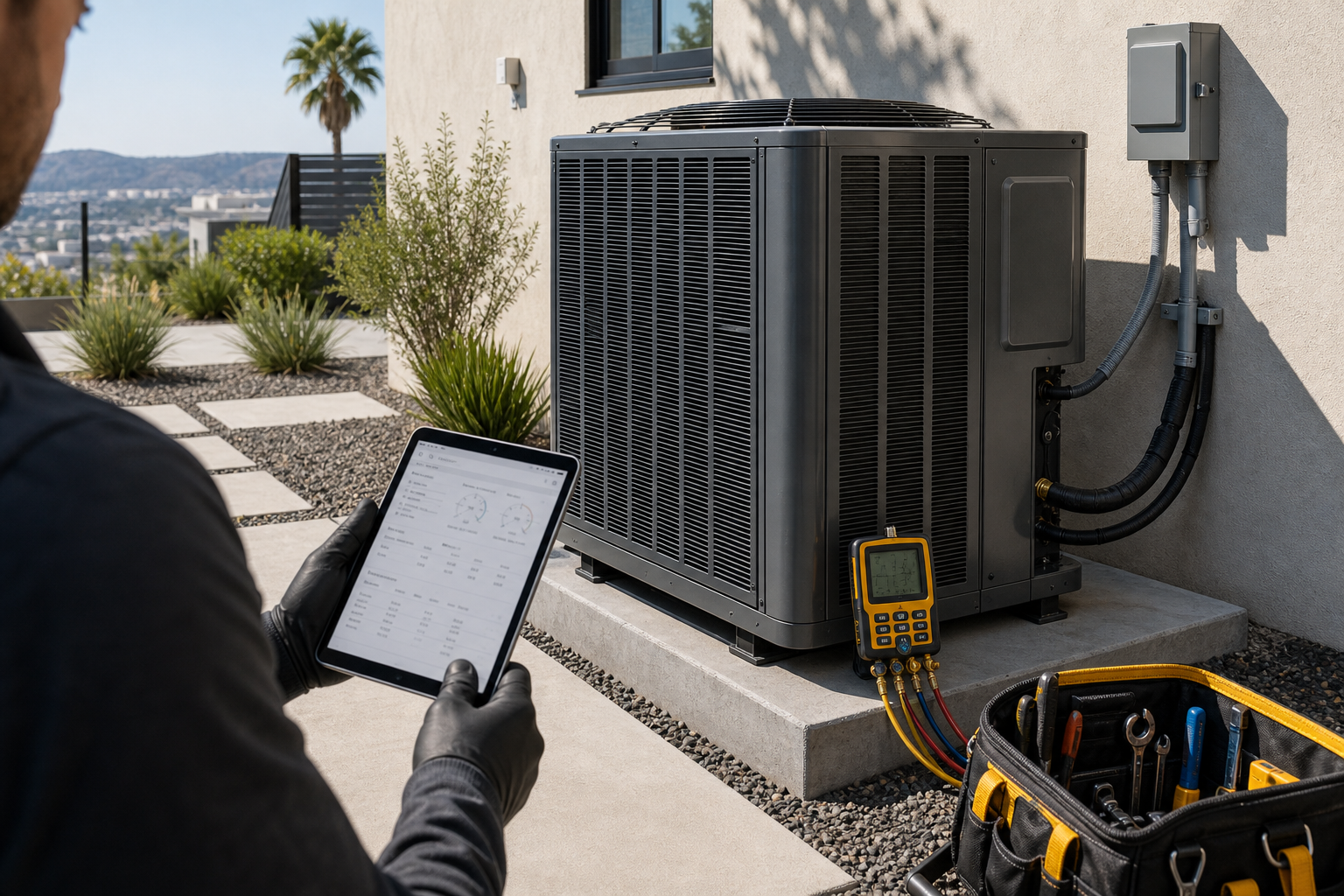
What changes about a heat pump install once you cross into Long Beach
Long Beach's building stock spans a century in a few square miles. Belmont Heights and Belmont Shore hold 1920s Craftsman bungalows and Spanish revivals that often still run gravity furnaces through original ducts; Bixby Knolls' 1940s and 1950s ranches have usable attics and are good candidates for variable-speed split systems; Naples' canal-front homes are dense, walled, and constrained on outdoor unit placement. The city runs its own Building Department and its own utility, Long Beach Utilities, which means heat-pump rebates and panel upgrade coordination route differently than they do under LADWP — a fact that surprises homeowners moving from the Westside. Marine influence keeps the airport pocket cooler than the East Side, but the Wrigley and Cal Heights inland neighborhoods can run ten degrees hotter on a Santa Ana afternoon. We typically pair a Bosch IDS Ultra or Carrier Infinity heat pump with an ERV sized to ASHRAE 62.2-2022, especially in walled Naples lots where natural ventilation is limited. Title 24 §150.2(b) and the city's own HERS verification expectations apply on every alteration permit. Commissioning documents the refrigerant subcool, the duct leakage to outside, and the matched AHRI certificate before we close the job.
A heat pump install on paper is identical from one Long Beach block to the next. The installed result is not. bungalows, condos, apartments, older ducts, and light commercial roof units and port-adjacent particles, coastal corrosion, tenant timing, and mixed building ages push the equipment in different directions, and condo approvals, rooftop equipment, ductless options, and older filter cabinets dictates how the crew can reach it. Cali HVAC treats those three variables as the actual scope, not the marketing.
A useful Long Beach field walk produces a written record, not a sales summary. We document static pressure and thermostat staging, sketch the access path, photograph the existing equipment plate, and note what the Harbor coast is asking the system to handle this season. Manual J load assumptions, Manual S equipment fit, duct static pressure, return-air capacity, and whether the home needs dual-fuel or all-electric sequencing. The heat pump install proposal that follows references those notes by line, so the homeowner can see what the readings drove and what was assumed.
The shape of an honest heat pump install proposal is closer to a contract than a quote. For a Long Beach project that means the equipment match, the route, the drainage and electrical scope, the controls plan, the photo log, and the document set are all called out by name with the assumptions that make them work. closeout evidence matters when owners, tenants, and building access rules overlap, which is why we will not quote a tonnage and a price without the rest of the file behind it.
Searches like "Long Beach heat pump install" deserve to land somewhere that names the install risks instead of softening them. oversized equipment short cycling bedrooms is common in bungalows, condos, apartments, older ducts, and light commercial roof units; old ducts copied without testing shows up often enough that ignoring it is a planning failure. Ducted systems can preserve a central layout when the duct system is healthy; ductless or short-run ducted systems can be better when old ducts cannot carry the load.. The bid worth signing acknowledges those risks and writes the contractor's responsibility limits next to them, in plain English, before install day.
If the closeout fits in an envelope, it is incomplete. The Long Beach heat pump install package we hand over includes equipment matchup sheet, startup readings, static pressure notes, filter size and warranty handoff, model and serial photographs, filter dimensions, control configuration, and operating notes that explain what normal looks like. closeout evidence matters when owners, tenants, and building access rules overlap, which is why the proof pack is the deliverable, not the equipment receipt.
We treat heat pump installation as the high-stakes moment it actually is. A Long Beach homeowner who replaces wrong inherits years of comfort gaps, runtime penalties, and warranty arguments that no one warned them about. The remedy is to settle condo approvals, rooftop equipment, ductless options, and older filter cabinets questions on paper, name oversized equipment short cycling bedrooms and old ducts copied without testing in the bid, and start install day with the surprises already discovered and priced.
The reason Cali HVAC writes city-by-city instead of one Los Angeles page is that Long Beach is not interchangeable with the next ZIP. port-adjacent particles, coastal corrosion, tenant timing, and mixed building ages from the Harbor coast change runtime and filtration math; bungalows, condos, apartments, older ducts, and light commercial roof units changes labor and routing math. A heat pump install scope that does not name those differences is a template, and templates underperform here in predictable ways.
A measured heat pump install also protects premium brands. Mitsubishi, Daikin, Bosch, Trane, Carrier, Lennox, Fujitsu, and other reputable equipment can underperform when airflow, controls, line lengths, filter pressure drop, or charge procedure are neglected. The brand name is only one input. Commissioning is what proves the equipment was asked to do a realistic job.
What Long Beach buildings demand from a Heat Pump Install
Local proof angle for Long Beach heat pump install.
A bid that names the failure mode is more honest than a bid that names a discount. For Long Beach, the scope should explain how condo approvals, rooftop equipment, ductless options, and older filter cabinets affects equipment placement, airflow, controls, drainage, finish protection, and the final owner record. A city-service page only earns its keep when it gives the homeowner a sharper checklist than a broad Los Angeles service page.
That is why the heat pump install conversation starts with the home: bungalows, condos, apartments, older ducts, and light commercial roof units. The same service can be easy in a flat postwar attic and difficult in a hillside remodel, ADU, condo stack, or coastal roof. The proposal should make those constraints visible before the old system is removed.
Verification milestones inside a Long Beach Heat Pump Install
Heat Pump Install commissioning focus in Long Beach.
The minimum written scope should describe load assumptions, AHRI matchup, refrigerant charge, static pressure, thermostat staging, then connect each checkpoint to a finished deliverable. If the contractor says the system will be quiet, efficient, smoke-ready, rebate-ready, or better balanced, the closeout file should show which readings, photos, settings, or caveats support that claim.
For Long Beach searches, long-tail intent usually means the homeowner already knows the service category and wants a local risk answer. Common issues such as old ducts copied without testing, panel capacity assumed too late, oversized equipment short cycling bedrooms should not be discovered after equipment is ordered. They belong in the pre-install notes, with the limits stated plainly when the building will not let the system perform like a brochure.
What to look for when Long Beach heat pump install bids look identical on paper
Long Beach heat pump install planning range before access.
A premium label can raise the ceiling, but it cannot overcome poor installation discipline. The quote that looks expensive may be the better value if it includes model-match evidence, startup values, route photos, filter and control setup, warranty handoff, and clear exclusions. The quote that looks cheaper can become costly when it skips the proof points that decide comfort.
Cali HVAC treats the closeout as part of the product. For a Long Beach heat pump install, that means the homeowner should receive equipment matchup sheet, startup readings, static pressure notes, filter size and warranty handoff in a format that can be used by a future technician, property manager, warranty desk, rebate reviewer, or owner representative.
Records that follow a Long Beach heat pump install after closeout
Long Beach heat pump install paperwork context.
SCE territory changes the incentive research path, so the page should avoid LADWP-only promises while still documenting permits, AHRI matches, equipment ratings, and closeout proof. For heat pump installation, the research-backed document list is AHRI match, paid invoice detail, final approved permit, SEER2/HSPF2 tier, thermostat or staging setup, and any program caveat that could change eligibility. LADWP currently publishes heat pump HVAC rebate tiers up to $2,500 per ton for qualifying systems, but it also ties eligibility to rules such as AHRI match, final approved Building and Safety permit, SEER2/HSPF2 rating, and available program funding. That is why the proposal should never treat a rebate as guaranteed money until the installed system and paperwork are confirmed.
Permitting deserves the same discipline. CSLB C-20 guidance and Los Angeles mechanical-permit references support a simple homeowner question: who is responsible for the permit record, final inspection, and closeout documents? In Long Beach, that question matters before equipment is ordered because condo approvals, rooftop equipment, ductless options, and older filter cabinets. A clean heat pump install scope should state whether permit fees, HERS or field verification, electrical work, duct sealing, asbestos exclusions, HOA packets, or rebate filing support are included or excluded.
The Long Beach Heat Pump Install concerns that decide which bid gets accepted
Long Beach search intent for heat pump install.
The useful searcher is not asking "what is HVAC?" They are asking whether homeowners are usually comparing gas-furnace replacement, AC replacement, panel readiness, and whether a ducted or ductless heat pump can qualify for a utility incentive. A page built for that intent should answer the decision instead of repeating broad comfort language. For this service, the field answer is Manual J load assumptions, Manual S equipment fit, duct static pressure, return-air capacity, and whether the home needs dual-fuel or all-electric sequencing. That gives the homeowner a way to compare proposals using evidence instead of sales adjectives.
Ducted systems can preserve a central layout when the duct system is healthy; ductless or short-run ducted systems can be better when old ducts cannot carry the load. The best bid should make that tradeoff visible with photos, model numbers, installation constraints, startup readings, and plain-language exclusions. That keeps this page away from doorway behavior because the content is tied to a real Long Beach installation decision, a specific service, and documentation a homeowner can actually request.
Technical detail: how a Heat Pump Install actually gets commissioned
Heat pump installs in Los Angeles live or die on the Manual J load calc and the AHRI matched-system certificate — skip either and the LADBS mechanical permit closeout will bounce, and LADWP will reject the Consumer Rebate Program paperwork that pays $2,500 per ton on HSPF2 ≥ 8.5 tier-2 equipment. On a typical 1,650 sqft Mar Vista bungalow with R-13 walls and single-pane west glazing I size to 30,000 BTU cooling and run a Mitsubishi MXZ-3C30NAHZ2 hyper-heat outdoor with a wall-mounted MSZ-FH12NA in the primary bedroom and a SVZ-KP18NA ducted air handler feeding the rest of the house — that combination clears 22 SEER2 and HSPF2 10.5, which is the threshold the homeowner needs to stack the LADWP tier-2 rebate with the federal 25C credit. For full-electric retrofits where the existing furnace closet is undersized I have moved to the Carrier Greenspeed 25VNA8 paired with an FV4CNF005 fan coil because the variable-speed compressor modulates down to roughly 25% capacity and avoids the short-cycling I see on single-stage 4-ton condensers in 1,400 sqft Eagle Rock houses. Every install gets pulled to 500 microns and held for 30 minutes with the micron gauge isolated from the pump, line-set brazed under nitrogen at 2 to 3 psi flow, and HERS field verification on refrigerant charge and airflow per Title 24 Part 6 §150.2(b). NEC 110.26 working clearance and NEC Article 440 disconnect placement get checked before drywall closes — that is the failure mode that kills final inspection.
Proof checklist for a Heat Pump Install in Long Beach
- Manual J load calc room-by-room with window orientation and infiltration
- AHRI 220xxxxxxx matched-system certificate listing exact outdoor and indoor model
- vacuum log showing 500 microns held 30 minutes with isolation valve closed
- HERS field verification report for refrigerant charge and airflow
- LADWP rebate eligibility printout confirming HSPF2 ≥ 8.5 tier 2
- 12-year compressor and parts warranty registration confirmation email
- LADBS mechanical permit final card signed off by district inspector
- photo of brazed line-set joints with nitrogen flow tag
Long-tail questions homeowners ask about a Long Beach Heat Pump Install
- LADWP Consumer Rebate Program heat pump $2500 per ton documentation requirements
- Mitsubishi MXZ-3C30NAHZ2 hyper-heat install cost Los Angeles
- HSPF2 8.5 tier 2 LADWP rebate qualifying models 2026
- heat pump replacement gas furnace cost Mar Vista
- Carrier Greenspeed 25VNA8 FV4CNF005 matched system AHRI
- Title 24 Part 6 150.2(b) HERS refrigerant charge verification LA
- AHRI matched system certificate inverter heat pump Los Angeles
- 25C federal tax credit heat pump 2026 stacking LADWP rebate
- Manual J load calc heat pump 1650 sqft bungalow LA
- NEC 110.26 working clearance heat pump disconnect inspection LADBS
What belongs in the Long Beach closeout file
- equipment matchup sheet
- startup readings
- static pressure notes
- filter size and warranty handoff
- load assumptions
- AHRI matchup
- refrigerant charge
- static pressure
- thermostat staging
Data points used across this site are anchored to LADBS mechanical permits, 2025 California Energy Code, LADWP heat pump rebates, TECH Clean California reservation status, CSLB C-20 permit enforcement, California HERS field verification, ACCA Manual J S and D design, AHRI matched system certificates, ENERGY STAR quality installation, EPA wildfire smoke filtration, ENERGY STAR duct losses. Program details can change, so rebate, permit, and code assumptions should be verified at the time of installation.